Wednesday, October 29, 2014

Thinking about "Thinking, Fast and Slow" by Daniel Kahneman


After briefly outlining the trajectory of his research with Amos Tversky, Daniel Kahneman drops this little nugget in the introduction to Thinking, Fast and Slow:
By and large, ...the idea that our minds are susceptible to systematic errors is now generally accepted.
The irony is that few minds ever confront themselves in the critical ways necessary to fully come to terms with this. Most of us are simply unaware of the kinds of cognitive biases and unconscious processes that shape how and what we think. What is doubly ironic is that we are overly confident in our beliefs, impressions, and preferences for no good reason. We seldom ask ourselves why we think what we do. Nor do we often consider the possibility that the conclusions we reach may be wrong and/or based on unfounded assumptions or unreliable information:
The confidence that individuals have in their beliefs depends mostly on the quality of the story they can tell about what they see, even if they see little. We often fail to allow for the possibility that evidence that should be critical to our judgement is missing—what we see is all there is.
I can assert without hyperbole that the world would be a much better place if more people seriously contemplated how our thought processes are riddled with systematic errors, or that the idea of the self (that there is a coherent and essential "I" in all of us that is the conscious author of our thoughts) is an illusion. The notion that humans are fundamentally free and rational agents has been dramatically undermined by the findings of cognitive psychology. As a result, economics has undergone somewhat of a revolution in light of our new understand of human behaviour. Now, behavioural economics is all the rage!

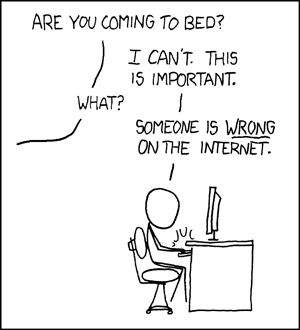
On a more personal level, accepting that our brains come loaded with biases can lead to better and more productive relationships and interactions. One of the main reasons I seek to learn about all the ways our intuitive reasoning fails us is so that I may be better equipped when I tell someone they are wrong on the internet. I readily admit that sometimes I just cannot help myself... (Wait, who is the "I" and "myself" in this sentence? Why should they be at odds and struggling for control? Just who is in charge here, anyway?)


http://xkcd.com/386/

So after seeing many references to Kahneman's work in other books, and seeing him in an episode of BBC Horizon called "How You Really Make Decisions", I finally picked up a copy of Thinking, Fast and Slow a few weeks ago at a used book store (hardcover in great condition). Better late than never, I guess.

And if this isn't a nearly perfect description of what it's like to be a "confident idiot" in a complex world, then I don't know what is:
A remarkable aspect of your mental life is that you are rarely stumped. True, you occasionally face a question such as 17 x 24 = ? to which no answer comes immediately to mind, but these dumbfounded moments are rare. The normal state of your mind that you have intuitive feelings and opinions about almost everything that comes your way. You like or dislike people long before you know much about them; you trust or distrust strangers without knowing why; you feel that an enterprise is bound to succeed without analyzing it. Whether you state them or not, you often have answers to questions that you do not completely understand, relying on evidence that you can neither explain or defend.

Sunday, October 19, 2014

They're illusions, Michael: "Waking Up" by Sam Harris


Although we are only beginning to understand the human mind at the level of the brain, and we know nothing about how consciousness itself comes into being, it isn't too soon to say that the conventional self is an illusion. There is no place for a soul inside your head. Consciousness itself is divisible—as we saw in the case of split-brain patients—and even in an intact brain consciousness is blind to most of what the mind is doing. Everything we take ourselves to be at the level of our subjectivity—our memories and emotions, our capacity for language, the very thoughts and impulses that give rise to our behavior—depends upon distinct processes that are spread out over the whole brain. Many of these can be independently interrupted or extinguished. The sense, therefore, that we are unified subjects—the unchanging thinkers of thoughts and experiencers of experience—is an illusion. The conventional self is a transitory appearance among transitory appearances, and it vanishes when looked for.
Em-dash overuse notwithstanding, this is such a good summary of how the self is an illusion that it should be printed up on little cards and handed out to people on the street. It is no coincidence that this passage appears near the end of a terrific book which also extolls (among many other fascinating and enlightening things) the importance of having a competent teacher who can point a student in the right direction on the contemplative path of inner exploration. 

Sam Harris has written another challenging and important book. It is also a necessary one. One of the many questions that invariably arises in response to the project of New Atheism to disabuse the world of faith-based malarkey is how is one supposed to find meaning in life without religion? It is not just believers who worry about this. It is not unlike the concern over whether humans can be moral without religion. In The Moral Landscape, Harris tackled this by showing how science and reason can guide us toward moral answers. Similarly, Waking Up provides us with good reasons for seeking spirituality (i.e. meaning) in a secular context through meditation and contemplating the nature of our own consciousness.

Not that "I" needed any further convincing but if one has lingering doubts about the death of dualism, Waking Up should close the case. Coming to terms with the fact that we are our brains is, as Sam Harris argues, liberating. That the stakes couldn't be any higher in recognizing this is illustrated by this eminently tweetable gem:
Confusion and suffering may be our birthright, but wisdom and happiness are available.
"I" mean, dude. Seriously. Admittedly, "I" was always going to like this book. Rarely are expectations so dramatically exceeded. The phrase gets thrown around quite a bit, but Waking Up truly is required reading. (Also, The Self Illusion by Bruce Hood.)

("I" briefly considered changing the title of this post to "Their illusions, Michael" which, I think, is funnier, but less clear and just looks like a typo instead of a reference.)

Wednesday, September 24, 2014

"The Sixth Extinction: An Unnatural History" by Elizabeth Kolbert

"Since the start of the industrial revolution, humans have burned through enough fossil fuelscoal, oil, and natural gas—to add some 365 billion metric tons of carbon to the atmosphere. Deforestation has contributed another 180 billion tons. Each year, we throw up another nine billion tons or so, an amount that's been increasing by as much as six percent annually. As a result of all this, the concentration of carbon dioxide in the air today—a little over four hundred parts per million—is higher than at any other point in the last eight hundred thousand years. If current trends continue, CO2 concentrations will top five hundred parts per million, roughly double the levels they were in preindustrial days, by 2050. It is expected that such an increase will produce an eventual average global temperature rise of between three and a half and seven degree Fahrenheit, and this will, in turn, trigger a variety of world-altering events, including the disappearance of most remaining glaciers, the inundation of low-lying islands and coastal cities, and the melting of the Arctic ice cap. But this is only half the story."

- The Sixth Extinction: An Unnatural History by Elizabeth Kolbert
Quoted, at length, for truth. What else is there to say? We done goofed.

Wednesday, September 17, 2014

HBO Documentaries: "Terror At The Mall" (2014)


Having survived the Westgate shopping mall attack in Kenya and speaking in the documentary Terror At The Mall, Amber Prior has this to say:
I don't really blame them as individuals. They really were just ordinary men with very, very wrong ideas about life. When I spoke to them there was a real calm and determination about what they were doing. You know, they were there to send out a message to the world, however messed up that message was, and to die doing it.
To survive such a horrible ordeal and still be able to think about it rationally in real terms... Brilliant. She's my fucking hero. 

Tuesday, September 16, 2014

Five* Albums I'm Really Into Right Now

Here are five* albums I'm really into right now (click image to be hear a song on the yootubes):

The War On Drugs - "Lost In The Dream"

http://youtu.be/1LmX5c7HoUw

FKA twigs - "LP1"

http://youtu.be/Cw6H9YsTLek

The Antlers - "Familiars"

http://youtu.be/7IA1Qucq20Y

Owen Pallett - "In Conflict"

http://youtu.be/HMr51844ybw

Tennis - "Ritual In Repeat"

http://youtu.be/JBhtE3qB35o

* Note: After a few complete listens, I am also thoroughly into the new (alt-J) record, "This Is All Yours" - but since it isn't really out yet, I chose not to include it in this list.

Wednesday, September 3, 2014

Nancy Writebol claims "God uses experimental drugs."


Nancy Writebol, an American medical missionary who recently recovered from Ebola gave a press conference today and said crazy things like this:
“The Lord came near, ‘Am I enough? Am I enough?’” My response to the Lord, was, ‘Yes you are enough.’”
And this:
“This is not our story, it is God’s story. God is writing this.”
Take THAT dead and dying Africans. If this is all part of god's plan, then he/she/it is a moral monster. If god didn't "write" this but allows it to occur, then he/she/it is a moral monster. If god is indifferent to this earthly suffering or is otherwise powerless to stop it, he/she/it is a moral monster and is hardly a god worth praising. This is inescapable.

The arrogance displayed in attributing one's survival to "god" or "faith" (who, mysteriously, works through medicine with experimental drugs that are developed slowly over time -- I mean, what's taking him/her/it so long to come up with the full blown cure?) in the face of so many deaths is truly reprehensible. The unmitigated gall of this woman!

Yes, I know Writebol fell extremely ill while trying to help people who are suffering from a terrible disease. It goes without saying that this should be commended. But if the Lord is "enough", why accept the medical treatment and experimental drugs at all? All I'm saying is, if I were the Lord, I'd be a little annoyed by this.

But then, this is the same Lord who is "writing" the story by creating these diseases only to work slowly and inefficiently through medical science, allowing doctors and researchers to pursue all sorts of blind alleys and dead ends before kinda sorta maybe hitting on something that might work. Meanwhile, the suffering is allowed to continue while he/she/it "works" in these mysterious ways as scientists take the heat for not having all the answers yet.

God gets all the credit and none of the blame. How convenient.

Monday, September 1, 2014

How Did It Come To This?: "Inferno" by Robert A. Ferguson


"Inmates have been judged to have brought whatever discomfort they suffer on themselves, and there is little desire to measure that discomfort. Hundreds will gather for candlelight services at the location of an execution. Yet few blink an eye over a sentence of life without parole. ...

"By keeping those in prison securely hidden from public view and by making sure that the criminals who perform serious crimes never reappear, society confirms that it does not want to think about whatever suffering takes place behind jailhouse walls even if it knows that humiliation, discomfort, crime, and physical abuse are prevalent there. Confusions in the relation of pain to punishment are masked by an indifference that controls communal attitudes toward the huge population in American prisons."
- Robert. A Ferguson, Inferno: An Anatomy of American Punishment
"The degree of civilization in a society can be judged by entering its prisons."
- Fyodor Dostoevsky [h/t "Con-Air" (1997)]
As I've become more interested in the How and Why of human violence and its historical trends, it was perhaps inevitable that I would seek a deeper understanding of crime and its causes and the administration of criminal justice. How the human animal (an evolved creature like any other, subject to and shaped by the pressures of natural selection) seeks to live in a civil society of its own design is about as an important area for critical examination as it gets. Nothing modest here. What constitutes a crime and why? How and why do people come to commit criminal acts in the first place? How and why do we treat criminals in the way we do? These are significant questions that should concern everyone in society.

Connected to the process of justice is how the system and its outcomes are perceived and interpreted by people in general, especially those who have little to no contact with it. One need look no further than the comments section of a news article or blog post about crime and/or the people who commit criminal acts to be confronted with an overarching and disturbing aspect of what Justice means to many people: Punishment.

Some vocal commenters, protected (and perhaps embiggened) by the distance and anonymity provided by the internet forum, are quick to revel in the need for ever harsher punishments for those who perpetrate heinous acts. Even if the idea of proportionality is brought up, that is, how long sentences should be relative to the severity of the crime, precisely what "doing time" entails is apparently seldom fully considered.

It is difficult to grasp intellectually what it truly means to be sent away to prison for a given number of years. Being denied personal freedom is seen as the just punishment for those who abuse said freedom. However, this is only part of the story. Consider the horrors prisoners must endure on a daily basis at the hands of other inmates and some prison "guards". We know the stories about rape and the terror of violent gang regimes and hierarchies. They have so permeated popular culture that they have almost become trivial, even comical. This is both ironic and tragic.

And yet, some people still feel that prisoners "deserve" to be subjected to this kind of hellish environment. They are criminals, they say, why should we care what their lives are like in prison? They should get what's coming to them. An eye for an eye, just deserts, and all that. To me, this is tantamount to sadism. Retribution is a slippery slope that makes us indifferent to or even suspect of the plight of prisoners, which invariably leads to a kind of punishment creep. They are still people after all. Even attempting to discuss the nightmare prison situation is to invite accusations of "siding" with the criminals over the victims. This is a false choice, and a lazy rhetorical tool. It is a serious impediment to peeling back the curtain on the current state of our punishment regime. We don't want to see how the sausage is being made, let alone consider that we may need to change the recipe.

A cursory examination of human nature reveals a tendency to take pleasure in inflicting punishment. This should give us pause. How could it be just for a person who possessed too much of the wrong kind of substance to be sent to a place where they are terrorized by rape, violence, and other shocking forms of abuse? Not to mention that prisons as they currently exists are effectively recidivism factories...

This is why when I stumbled upon Inferno: An Anatomy of American Punishment by Robert A. Ferguson on one of my daily internet wanderings, I knew it would be the book for me. I'm not even two chapters in and it is already evident that this book is dazzling in its scope with respect to legal theory, literature, history, and philosophy. As I read it, I feel as though I'm being let in on a secret. It's like I'm being presented with answers to the questions I only vaguely knew I had. But this is a retrospective conceit. Of course smart people have already been wondering and writing eruditely about these things! And this is exactly the book I've been waiting for.

Obviously, I would recommend this book to anyone involved with or interested in the criminal justice system. But since we all naturally feel as though we have an innate sense of justice and have an impulse to inflict punishment upon those who have done wrong, Inferno should be required reading for everyone. People are tried, sentenced, and punished on all of our behalf, so shouldn't we take an active and critical interest in how and why the system works the way it does?